 Logan Gelzer
Prioritize Shopify conversion rate optimization by fixing verified purchase blockers first, validating measurement next, and testing changes tied to a specific buying obstacle. Separate repairs from experiments: a broken add-to-cart interaction needs a fix, while a different product-page layout needs evidence. My recommendation for established DTC brands in 2026 is to scope the smallest useful development change before approving a theme rebuild or headless storefront.
- Shopify conversion rate optimization starts with purchase blockers and trustworthy measurement, not a redesign.
- Prioritize custom theme development around observed friction, implementation effort, and a measurable outcome.
- Logangelzer fits DTC brands seeking direct senior Shopify Plus development rather than account-manager handoffs.
- Choose Hydrogen for a defined storefront requirement, not as a substitute for diagnosing conversion problems.
Why this matters
An ecommerce backlog mixes different kinds of work: defects, merchandising changes, performance problems, experiments, and architectural decisions. Treating them as interchangeable makes prioritization harder. A cart defect and an untested homepage concept should not compete on presentation quality.
At Logangelzer, I offer custom theme development, Shopify Plus development, Hydrogen storefronts, checkout extensibility, and CRO/A-B testing. My advice is to choose the intervention after identifying the problem, not before. Access to a development capability does not make that capability the right next investment.
For your 2026 roadmap, the useful question is not simply whether a task sounds conversion-related. Ask what purchase obstacle it addresses, what evidence supports it, and how you will know whether the change helped.
How do you prioritize Shopify conversion rate optimization work?
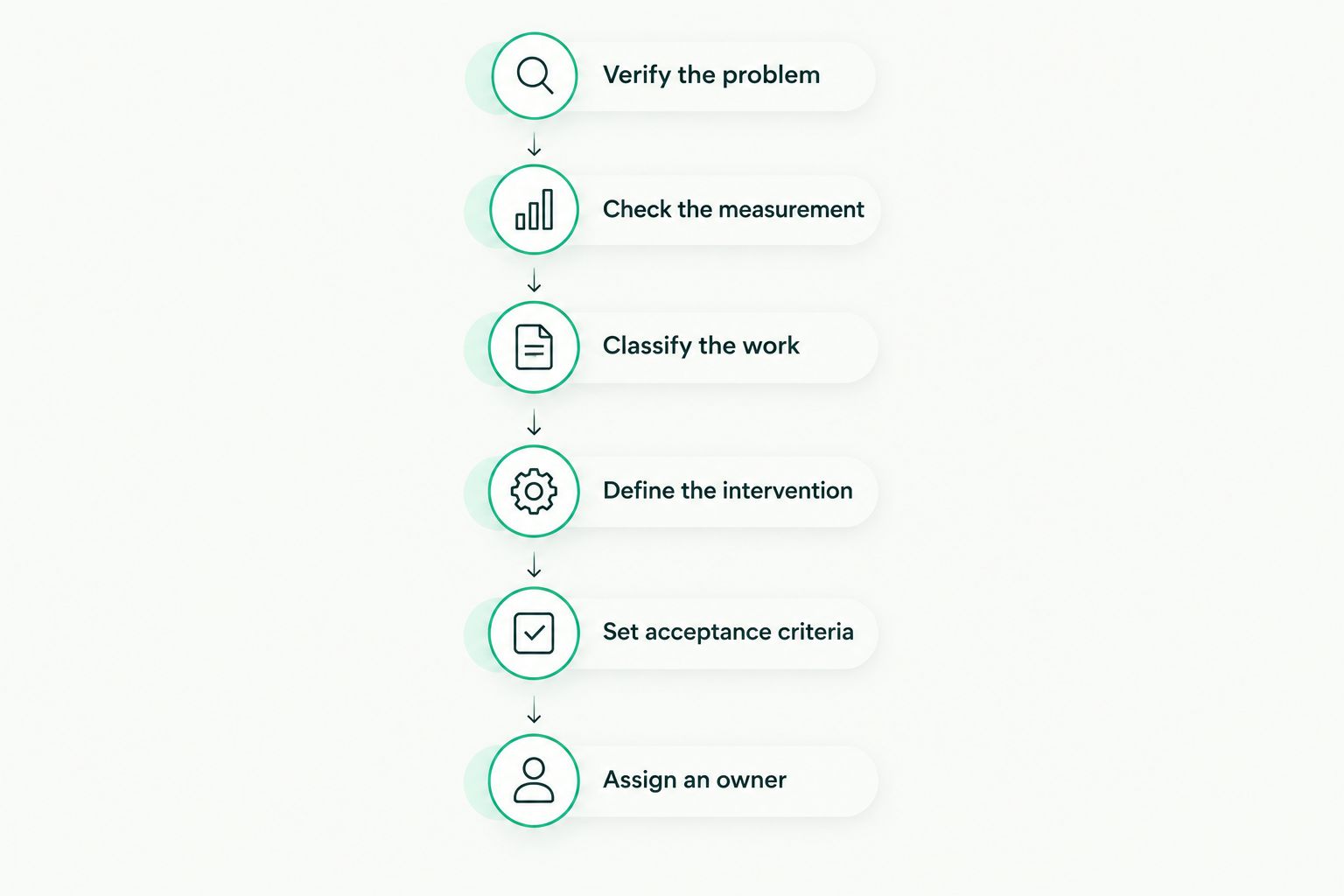
Use the following sequence to turn a broad CRO backlog into a development brief. Each step produces a decision that the next step depends on.
- Verify the problem. Reproduce the suspected issue or identify a consistent pattern in your own analytics. Record the affected page, device, traffic segment, and purchase action.
- Check the measurement. Confirm that the events used to evaluate the change represent the intended actions. Investigate missing events, duplicate events, and differences between reporting systems.
- Classify the work. Decide whether the task is a repair, an experiment, or an architectural requirement. Those categories need different approval criteria.
- Define the intervention. Specify the smallest change that addresses the problem without introducing unrelated design or platform work.
- Set acceptance criteria. Document functional requirements, measurement requirements, and conditions that trigger a rollback.
- Assign an owner. Name who implements the change, checks it, approves release, and evaluates the result.
The output should be a decision-ready scope, not a collection of screenshots labeled urgent. If your team cannot explain which buying obstacle a task addresses, keep it out of the development queue until that question is answered.
Which type of work belongs first?
This comparison separates corrective work from decisions that require a business case. The priority labels describe how I would assess a task, not a promise of conversion improvement.
| Work type | Best for | Main advantage | Main limitation | Priority rule |
|---|---|---|---|---|
| Purchase-blocking repair | A reproducible cart, variant, or checkout failure | Restores intended functionality | Does not prove wider conversion improvement | Fix before discretionary experiments |
| Measurement repair | Missing or inconsistent purchase-path events | Makes evaluation more dependable | Is not itself a storefront improvement | Resolve before relying on affected metrics |
| Custom theme experiment | A specific product-page or cart hypothesis | Keeps the intervention close to the observed friction | Needs a credible evaluation plan | Test after essential repairs |
| Checkout extensibility | A defined requirement inside supported checkout capabilities | Addresses checkout-specific functionality | Must respect platform and plan constraints | Scope against the exact requirement |
| Hydrogen storefront | A documented need for a custom headless frontend | Provides control over frontend implementation | Adds frontend ownership and integration responsibilities | Require an architectural business case |
A repair restores an intended behavior; an experiment tests whether a different behavior is better. Keep that distinction in your brief, budget approval, and reporting.
Fix purchase blockers before testing persuasion
A purchase blocker is a failure that prevents an intended action. Examples to check include a variant selection that does not update correctly, an add-to-cart interaction that fails, or an error that stops a shopper from progressing. These are diagnostic examples, not claims about your store.
Document the reproduction path before assigning the work. Include the device and browser, selected product configuration, relevant app interaction, and expected behavior. A developer should be able to repeat the failure without guessing what the shopper did.
For a 2026 release checklist, include the complete path from product selection through checkout. Testing only the edited section misses interactions elsewhere in the purchase journey.
The advantage of repair work is a clear functional acceptance condition. Its limitation is equally important: fixing a defect does not establish a specific revenue uplift. Report the corrected behavior separately from any subsequent change in commercial performance.
Make measurement trustworthy before declaring a winner
Before testing a layout or interaction, establish what the measurement actually captures. A product-page event, cart event, and completed order represent different actions. Do not use them interchangeably because one is easier to report.
Choose a primary outcome tied to the hypothesis. If a change concerns product selection, inspect the relevant interaction as well as the downstream purchase outcome. Keep secondary measures available to detect tradeoffs rather than using them to rescue an unsuccessful test.
Write down how your team will handle campaign changes, promotions, product assortment changes, and releases that overlap with the evaluation. These conditions can complicate interpretation; recording them prevents a clean-looking chart from becoming an unsupported explanation.
Do not call a before-and-after difference an A/B test. A controlled comparison and an observational comparison support different conclusions. Agree on the evaluation method before implementation, not after seeing the result.
Prioritize custom theme changes with a specific hypothesis
Custom theme development belongs near the top of the backlog when a documented obstacle exists in the theme and the change can be scoped clearly. Start with the interaction involved, not a request to make the page feel more premium.
A useful hypothesis connects an observation, an intervention, and an outcome. For example: shoppers cannot distinguish product options clearly; change the option presentation; evaluate option-selection behavior and completed purchases. The observation must come from your evidence before this becomes an approved task.
Avoid bundling unrelated changes into the same experiment. Replacing the product gallery, navigation, option selector, and cart together makes attribution difficult. If those changes are required as a coordinated redesign, call the project a redesign and evaluate it accordingly.
My recommendation is to preserve the existing purchase path unless the evidence identifies it as the problem. A custom theme offers implementation control, but every additional behavior also creates something your team must test and maintain.
Where does storefront performance fit?
Performance belongs in the backlog when measurements identify a problem on relevant pages or interactions. It should not become a separate competition to produce the most attractive audit score.
For a 2026 performance review, Google's Core Web Vitals provide publicly documented thresholds for the good category:
- Largest Contentful Paint: 2.5 seconds or less. This measures when the largest visible content element renders.
- Interaction to Next Paint: 200 milliseconds or less. This measures responsiveness to user interactions.
- Cumulative Layout Shift: 0.1 or less. This unitless score measures unexpected layout movement.
Google evaluates these thresholds at the 75th percentile of page visits. These are user-experience benchmarks, not promised conversion gains. Separate field measurements from controlled lab diagnostics when deciding what to fix.
Scope the affected template and behavior. An unstable product-page control deserves a different investigation from a slow editorial image. Inspect scripts, media, theme code, and app interactions before deciding that the entire storefront architecture must change.
Why Shopify conversion rate optimization priorities vary
There is no useful universal backlog that places the same task first for every established DTC store. I use these factors to decide what merits development attention:
- Observed severity: A verified purchase failure takes precedence over an untested presentation preference.
- Affected journey: Record whether the issue concerns product selection, cart behavior, or checkout rather than treating every page equally.
- Evidence quality: Reproducible defects and trustworthy measurements support different decisions from an isolated comment.
- Implementation scope: A contained theme change and a storefront architecture project require different commitments.
- Evaluation readiness: A test needs a defined outcome and an evaluation method that fits the store's traffic and operating conditions.
- Maintenance ownership: Identify who supports the code, integrations, and measurement after release.
These factors create a defensible order without invented precision. A numerical priority score is not evidence by itself; the assumptions behind it still need review.
Should you hire a freelancer or a Shopify development agency?
Match the delivery model to the work. A scoped theme or Shopify Plus project and a coordinated program spanning several disciplines do not have identical staffing needs.
Logangelzer is best for established DTC brands seeking direct senior Shopify Plus and custom theme development. I bring 12+ years of experience and direct access without account-manager handoffs. Those are service characteristics, not evidence of a guaranteed conversion result.
| Delivery model | Best for | Advantage to assess | Tradeoff to assess |
|---|---|---|---|
| Working directly with Logan | A defined Shopify development scope with a clear client-side owner | Direct technical discussion with the developer | Confirm capacity, support coverage, and dependencies |
| Shopify development agency | Work requiring coordinated delivery across multiple disciplines | A team structure that matches the project | Confirm who implements the work and how decisions reach that person |
Neither model substitutes for a good brief. Ask each provider how they separate defects from experiments, document acceptance criteria, and handle deployment or rollback. Compare their proposed scope before comparing the delivery structure.
The guide to hiring a freelance Shopify developer or an agency covers that provider decision separately from the CRO backlog.
Do you need Hydrogen to improve Shopify conversion rates?
Hydrogen is an architectural choice, not a conversion-rate treatment. Choose it when a documented storefront requirement justifies a custom headless frontend, not because the existing store has an unexplained conversion problem.
My advice for a 2026 roadmap is to establish what a custom theme cannot reasonably deliver before proposing a headless rebuild. Include frontend maintenance, integrations, analytics, preview workflows, and release ownership in that decision.
Hydrogen gives developers control over the frontend, but that control carries implementation responsibilities. A theme-based intervention is the better fit when it addresses the verified issue without changing the operating model.
What should you send a developer before starting CRO work?
Send a brief that explains the decision, not just the desired appearance. Include the observed problem, reproduction steps or evidence, affected templates, relevant apps, proposed outcome, and constraints.
Separate required functionality from ideas to test. Identify the person who approves changes and the person who owns measurement. If checkout is involved, state the exact behavior you need rather than requesting generic checkout optimization.
For your 2026 project brief, also document release dependencies and rollback conditions. That gives the developer a concrete scope and gives your team a clear basis for accepting the work.
Discuss a scoped Shopify project
Bring a verified purchase obstacle, affected templates, and measurement requirements for a technical discussion.
FAQ
What's the first Shopify conversion rate optimization task to prioritize?
Fix a verified purchase blocker before discretionary experiments. Validate the affected measurement before using it to judge subsequent changes.
Should I redesign my Shopify store if conversion rates fall?
A conversion-rate decline alone does not justify a redesign. Check measurement, traffic composition, purchase-path functionality, and overlapping commercial changes before approving design work.
Is a custom Shopify theme better than Hydrogen for CRO?
A custom Shopify theme is the better fit when it solves the documented problem without requiring a headless frontend. Hydrogen needs a separate architectural justification and an explicit maintenance plan.
How fast should a Shopify store be in 2026?
Google's good Core Web Vitals thresholds are LCP at 2.5 seconds or less, INP at 200 milliseconds or less, and CLS at 0.1 or less. Google assesses these at the 75th percentile; they are not conversion guarantees.
Should I hire a freelancer or an agency for Shopify CRO development?
Choose the delivery model that matches the scope and staffing requirements. Logangelzer suits established DTC brands seeking direct senior Shopify development; assess an agency when the project needs coordinated delivery across disciplines.
Can a Shopify developer guarantee a conversion-rate increase?
A development scope can specify functional acceptance criteria, but it should not guarantee an unverified conversion-rate increase. Define the hypothesis, measurement method, and decision criteria before the work begins.
What should a Shopify CRO project brief include?
Include the observed problem, evidence, affected templates, relevant integrations, desired outcome, and acceptance criteria. Name the approval and measurement owners, and document release and rollback requirements.
One last thing
Put a rejection criterion beside every proposed experiment. State what result would make you leave the current implementation unchanged or restore it. That makes the project a test of a buying hypothesis rather than a search for reasons to keep new code.
If a task has no documented problem, no accountable owner, and no evaluation plan, my recommendation is simple: do not send it to development yet. Improve the brief first.