 Logan Gelzer
Evaluate a Shopify Plus developer by checking relevant implementation work, testing technical judgment against your actual requirements, and confirming who will build and maintain the storefront. A portfolio alone does not establish fit: require a clear explanation of ownership, architecture, checkout constraints, testing, and release responsibilities before hiring.
- Choose a Shopify Plus developer who can explain relevant work, technical decisions, and release responsibilities.
- Logangelzer is best for DTC brands seeking direct access to a senior Shopify Plus developer.
- Custom theme development and Hydrogen require different evidence; evaluate the architecture your project actually needs.
- Compare freelancers and agencies on named responsibilities, delivery coverage, and ongoing maintenance—not presentation quality.
I'm Logan at Logangelzer. I bring 12+ years of experience and Shopify Plus and Hydrogen expertise, with direct access rather than account-manager handoffs. My recommendation is to evaluate the person doing the implementation, not just the proposal describing it.
How do you evaluate a Shopify Plus developer before hiring?
Use the same evaluation process for every candidate. In 2026, familiarity with Shopify is not enough: your developer needs to distinguish theme work, checkout extensions, backend logic, and headless storefront responsibilities.
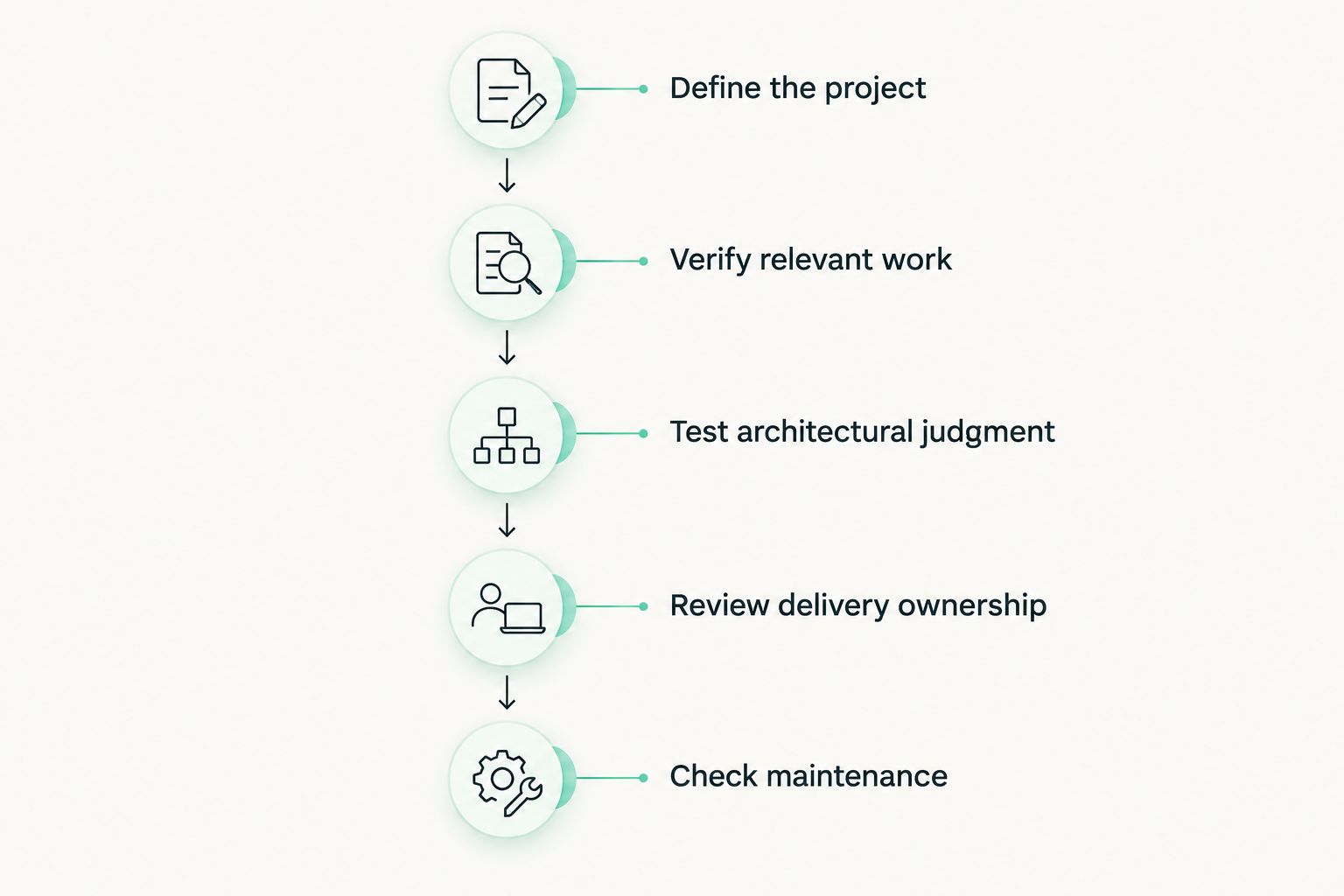
- Define the project. Describe the commercial problem, current storefront, affected customer journeys, integrations, and internal ownership. Ask candidates to identify what remains unclear before suggesting a solution.
- Verify relevant work. Request examples that match your requirements. Have the candidate distinguish personal implementation work from work delivered by a wider team.
- Test architectural judgment. Ask how the candidate would approach your project, what alternatives exist, and why the proposed approach fits. A useful answer includes limitations.
- Review delivery ownership. Establish who writes code, reviews changes, tests integrations, authorizes releases, and responds to production issues. Put those responsibilities in the proposal.
- Check maintenance. Ask how your team will edit content, understand custom features, manage credentials, and commission future changes after delivery.
A polished demonstration is not a substitute for these answers. Hire for relevant evidence and explicit responsibility, not a collection of platform names.
Why this matters
A DTC storefront connects merchandising, acquisition, checkout, subscriptions, analytics, and fulfillment. A change that looks isolated in a design file can affect several operational workflows.
Your hiring process should expose those dependencies before implementation starts. In 2026, the practical question is not whether a candidate can build a page; it is whether the candidate can explain how that page behaves within your business.
Ask your ecommerce lead and technical owner to review the same scope. Disagreement about editable content, integration ownership, or release approval is a project-definition problem—not something to leave for the developer to discover during delivery.
What evidence should a Shopify Plus developer show?
Request work that resembles the implementation you need. A custom theme project is relevant to theme architecture and merchandising; it does not, by itself, demonstrate Hydrogen or checkout-extension experience.
For each example, ask the candidate to explain:
- Personal contribution: What did the candidate implement, and what belonged to designers, other developers, or the client's team?
- Technical decision: Why was that approach selected over the alternatives?
- Business constraint: Which merchant requirement shaped the solution?
- Verification: How was the implementation tested before release?
- Maintenance: What did the merchant need to manage afterward?
Confidentiality can prevent access to repositories or client details. Accept an anonymized walkthrough that still explains the implementation and ownership clearly; do not demand disclosure of another merchant's private information.
Treat performance and conversion claims separately from the portfolio. A screenshot of an improved metric needs a measurement window, scope, and explanation of other changes made during that period. Without those details, it is an unsupported attribution—not evidence that the same result will follow on your storefront.
Custom theme or Hydrogen: which experience matters?
Choose the architecture before choosing the portfolio you consider relevant. My professional judgment is to start with the merchant's requirements, not a preference for headless development.
| Approach | Best for | Strength to evaluate | Tradeoff to examine |
|---|---|---|---|
| Custom Shopify theme | Brands whose requirements fit Shopify's theme architecture | Liquid, sections, reusable components, and merchant editing | Custom behavior must work within theme and platform boundaries |
| Hydrogen storefront | Brands with requirements that justify a custom storefront architecture | React, storefront data access, routing, caching, and deployment | The project includes storefront infrastructure and maintenance responsibilities beyond theme development |
For custom theme development, ask how sections and templates support your merchandising workflow. Have the candidate explain which changes your team can make through the theme editor and which require code.
For Hydrogen, ask who owns hosting, deployments, storefront data handling, analytics implementation, and monitoring. Request an explanation of the customer journey through cart and checkout rather than a demonstration of the homepage alone.
In a 2026 proposal, an architectural recommendation should name both the requirement it solves and the responsibility it adds. Do not accept Hydrogen as the default merely because the candidate prefers React. Equally, do not insist on a theme when the candidate demonstrates a specific requirement that needs a different approach.
How should you test checkout and integration knowledge?
Give candidates an actual requirement from your project. Ask them to separate what belongs in the storefront, what belongs in checkout, and what requires backend logic or an app integration.
Checkout Extensibility and Shopify Functions address different kinds of customization. A developer should explain which extension point or Function capability fits your requirement, what access is required, and what platform restrictions apply.
Avoid asking for memorized platform trivia. Use a scenario such as a promotion rule, subscription purchase flow, or checkout message, then ask the candidate to explain the implementation boundary and failure cases.
For Recharge, Klaviyo, or another named integration in your stack, request an ownership map. Who controls configuration? Where do customer events originate? What happens when an external request fails or an event is duplicated?
A credible answer identifies what needs checking in the current documentation and your account configuration. Technical confidence means explaining constraints accurately, not claiming every requirement is possible.
Direct freelancer or Shopify development agency?
Evaluate the working arrangement with the same care as the technical proposal. Neither a freelancer nor an agency is automatically the better choice.
| Provider model | Best for | Potential advantage | Tradeoff to verify |
|---|---|---|---|
| Direct freelancer | Brands seeking a direct relationship with the implementing developer | Technical discussion and implementation can sit with the same person | Capacity, specialist coverage, and continuity need explicit agreement |
| Development agency | Brands seeking a coordinated delivery team across disciplines | A staffed engagement can cover distinct project roles | Confirm the actual implementers, communication route, and accountability |
Logangelzer is best for DTC brands seeking direct access to a senior Shopify Plus developer. That model gives you direct technical discussion, but it does not remove the need to agree on scope, availability, and responsibilities.
If an agency proposes a team, ask who will work on the project and how decisions reach those people. If a freelancer proposes direct delivery, ask how overlapping work, absence, and unfamiliar specialist requirements will be handled.
My advice is to compare named responsibilities rather than assumptions about either model. An agency introduction and a freelancer introduction should both end with a clear answer to: who owns the implementation you are buying?
Why does Shopify Plus developer fit vary?
Fit depends on the work your business needs, not just years of experience. Evaluate these factors against your own scope:
- Storefront architecture: Theme development and Hydrogen require different implementation evidence.
- Customization boundary: Checkout, storefront presentation, and commerce logic need different technical approaches.
- Integration dependencies: Existing apps and external systems affect testing and ownership.
- Merchant workflow: Your team needs an agreed level of control over content and merchandising.
- Delivery model: Direct access, team coverage, review responsibilities, and maintenance must match your operating needs.
Use these factors to explain your decision internally. A candidate can be technically capable and still be a poor match for the project you are commissioning.
What should a credible proposal include?
The proposal should translate the conversation into decisions your team can approve. In 2026, a list of deliverables without acceptance criteria leaves too much room for conflicting interpretations.
Require the following:
- Scope boundaries: Included pages, features, integrations, and explicit exclusions.
- Dependencies: Access, design assets, merchant decisions, and third-party work required before implementation.
- Acceptance criteria: The behavior that establishes each deliverable is complete.
- Release process: Testing environment, approval owner, deployment steps, and recovery procedure.
- Handover: Documentation, repository access, credentials ownership, and ongoing maintenance responsibilities.
For custom themes, acceptance criteria should cover merchant editing as well as customer-facing behavior. A section that renders correctly but cannot support the agreed merchandising workflow is not complete.
For checkout or integration work, include unhappy paths: invalid input, failed requests, missing data, and interrupted customer journeys. Ask how the developer will test those conditions, not just the successful demonstration.
How do you assess performance claims?
Separate a controlled test result from real-user performance. A candidate should explain the test environment, page type, device conditions, measurement date, and whether the result reflects laboratory or field data.
Google's published Core Web Vitals thresholds provide a useful reference: good Largest Contentful Paint is 2.5 seconds or less, good Interaction to Next Paint is 200 milliseconds or less, and good Cumulative Layout Shift is 0.1 or less. These thresholds are assessed at the 75th percentile of page visits; they are not guarantees a developer can promise for every visitor.
For a 2026 hiring decision, use those thresholds to structure questions, not to accept an isolated score as proof. Ask which templates were measured, what scripts were present, and what changed between measurements.
Conversion claims require additional discipline. Ask whether the evidence comes from a controlled experiment or a before-and-after comparison, and what else changed during the measurement period. Technical delivery and commercial outcomes are connected, but attribution still needs evidence.
Should you pay for a technical discovery phase?
A defined discovery phase is useful when unresolved architecture, checkout, or integration questions prevent a credible implementation scope. Specify the output before commissioning it: a requirements assessment, architectural recommendation, dependency list, and delivery plan.
Do not accept an open-ended investigation without an agreed decision it should support. My recommendation is to use discovery to resolve uncertainty, not to rename a sales conversation.
Is Shopify Plus experience enough to hire someone?
Shopify Plus experience is necessary for platform-specific work, but it is not enough to establish fit. The developer also needs relevant implementation evidence, clear communication, and a delivery process your team can operate within.
Ask the candidate to explain one difficult tradeoff from relevant work. The answer should distinguish the merchant's constraint, the options considered, and the candidate's own contribution without turning into an unsupported success story.
FAQ
What's the best way to evaluate a Shopify Plus developer?
Evaluate relevant implementation evidence, architectural judgment, and delivery ownership against your project requirements. Ask who built the cited work, how it was tested, and what maintenance it required.
Should I hire a freelancer or a Shopify development agency?
Choose a freelancer for a direct delivery relationship or an agency when its proposed team coverage fits your scope. Verify the actual implementers and continuity arrangements rather than assuming either model is better.
Do I need a Hydrogen developer for a Shopify Plus store?
You need Hydrogen expertise when your project uses Hydrogen or your requirements justify that storefront architecture. Shopify Plus alone does not establish a need for headless development.
What should I ask about custom Shopify theme development?
Ask how templates, sections, and reusable components support your merchandising workflow. Confirm which changes your team can make through the theme editor and which require development.
How can I verify a developer's performance claims?
Request the measurement scope, date, environment, and distinction between laboratory and real-user data. An isolated score does not demonstrate performance across your storefront.
What should be agreed before a Shopify Plus project starts?
Agree on scope, acceptance criteria, dependencies, release ownership, and handover responsibilities. Include integration failure cases and merchant editing requirements where they apply.
Who is Logangelzer best for?
Logangelzer is best for established DTC brands seeking direct access to a senior Shopify Plus developer. Logan offers custom theme development, Hydrogen storefronts, checkout extensibility, and CRO/A-B testing services.
One last thing
Before signing, ask the developer to explain how your team would change a merchandising feature after handover. That question exposes the editing model, documentation quality, and boundary between routine operations and future development.
For your 2026 hiring decision, evaluate the storefront your team will operate—not just the launch your developer will deliver. If you want to work directly with me at Logangelzer, bring your current architecture, the commercial problem, and the requirements that cannot change.
Discuss your Shopify Plus project
Bring your custom theme requirements, current architecture, and integration constraints.