 Logan Gelzer
Established DTC brands’ Shopify development services are technical work on storefronts, integrations, and checkout with the aim of improving buying journeys and keeping ecommerce operations manageable. This 2026 guide explains how I recommend scoping custom themes, Shopify Plus work, and headless storefronts—and choosing between direct senior development and an agency.
- Logangelzer fits established DTC brands seeking Shopify development services with direct access to a senior Shopify Plus and Hydrogen developer.
- Choose custom theme development when your requirements fit Shopify’s theme architecture; require a specific business case for headless commerce.
- Compare a freelancer and an agency on delivery ownership, specialist coverage, and ongoing maintenance—not presentation quality.
- Define acceptance criteria for performance, checkout behavior, and merchant editing before approving a development scope.
Why Shopify development matters for established DTC brands
An established DTC store has more to protect than a launch date. Your development scope needs to account for existing merchandising workflows, integrations, measurement, and the customer journeys that already support your business.
I’m Logan, the developer behind Logangelzer. I bring 12+ years of experience, Shopify Plus and Hydrogen expertise, and direct access without account-manager handoffs. My recommendation is to choose the smallest technical change that solves the documented problem, then define how you will verify it.
Logangelzer is best for established DTC brands seeking Shopify development services with direct access to a senior Shopify Plus and Hydrogen developer. An agency is the better fit when your scope requires coordinated delivery across several disciplines and you want those responsibilities managed under one engagement.
For your 2026 roadmap, separate business needs from implementation preferences. A custom product page, checkout customization, and headless storefront are different projects; bundling them together without clear dependencies makes scope harder to evaluate.
How to scope and select Shopify development services
Define the business problem
Start with your existing analytics, support tickets, merchandising requests, and release history. You do not need a new platform or paid research tool to write down what is failing, who experiences it, and how the business will judge a fix.
Describe the problem before requesting an implementation. For example, an awkward product selection flow is a buying-journey problem; a request for a new framework is already a proposed solution. Keeping those separate gives a developer room to assess the right approach.
I recommend writing a brief that distinguishes documented evidence from assumptions. A conversion concern without supporting measurement belongs in the investigation scope, not in a promise of improved results.
- Business problem: Describe the customer or operational friction in plain language.
- Affected journeys: Name the templates, devices, and interactions involved.
- Existing evidence: Attach analytics findings, support examples, or reproducible defects.
- Success criteria: Define the observable behavior that would count as a fix.
- Scope exclusions: Record adjacent work that this engagement will not include.
Audit the current storefront before rebuilding
Use your current theme preview, browser developer tools, and existing reports to establish a baseline. Walk through product selection, cart changes, checkout entry, and merchant editing rather than reviewing the homepage alone.
Check where behavior comes from: theme code, an app, a third-party script, or a platform capability. That distinction affects who can change it and what needs testing afterward. A visual redesign does not, by itself, resolve an integration or tracking defect.
A senior developer can turn that inventory into a technical scope faster than a brief built only from screenshots. My Shopify development services include custom theme work, Shopify Plus development, checkout extensibility, and CRO/A-B testing; the problem determines which work belongs in the proposal.
- Theme inventory: Identify custom templates, sections, snippets, and dependencies.
- App dependencies: Record which apps control visible behavior or business rules.
- Performance baseline: Assess representative product, collection, and landing pages.
- Tracking baseline: Verify the events needed to evaluate the proposed change.
- Merchant editing: Test whether your team can update content without code changes.
Choose the architecture your team can maintain
Compare your requirements against the current storefront before choosing a replacement. Shopify theme development uses Liquid and the theme system; Hydrogen supports a custom headless storefront built with React. Those approaches create different development and maintenance responsibilities.
My default recommendation is to assess custom theme development before approving headless commerce. A theme keeps work within Shopify’s theme architecture, but it is not the right answer for every frontend requirement. Headless gives you a separate storefront implementation, with the additional responsibility of maintaining it.
For a 2026 Hydrogen decision, require a written explanation of what the current architecture cannot meet. Include content workflows, integrations, deployment, and future ownership—not just the desired visual design.
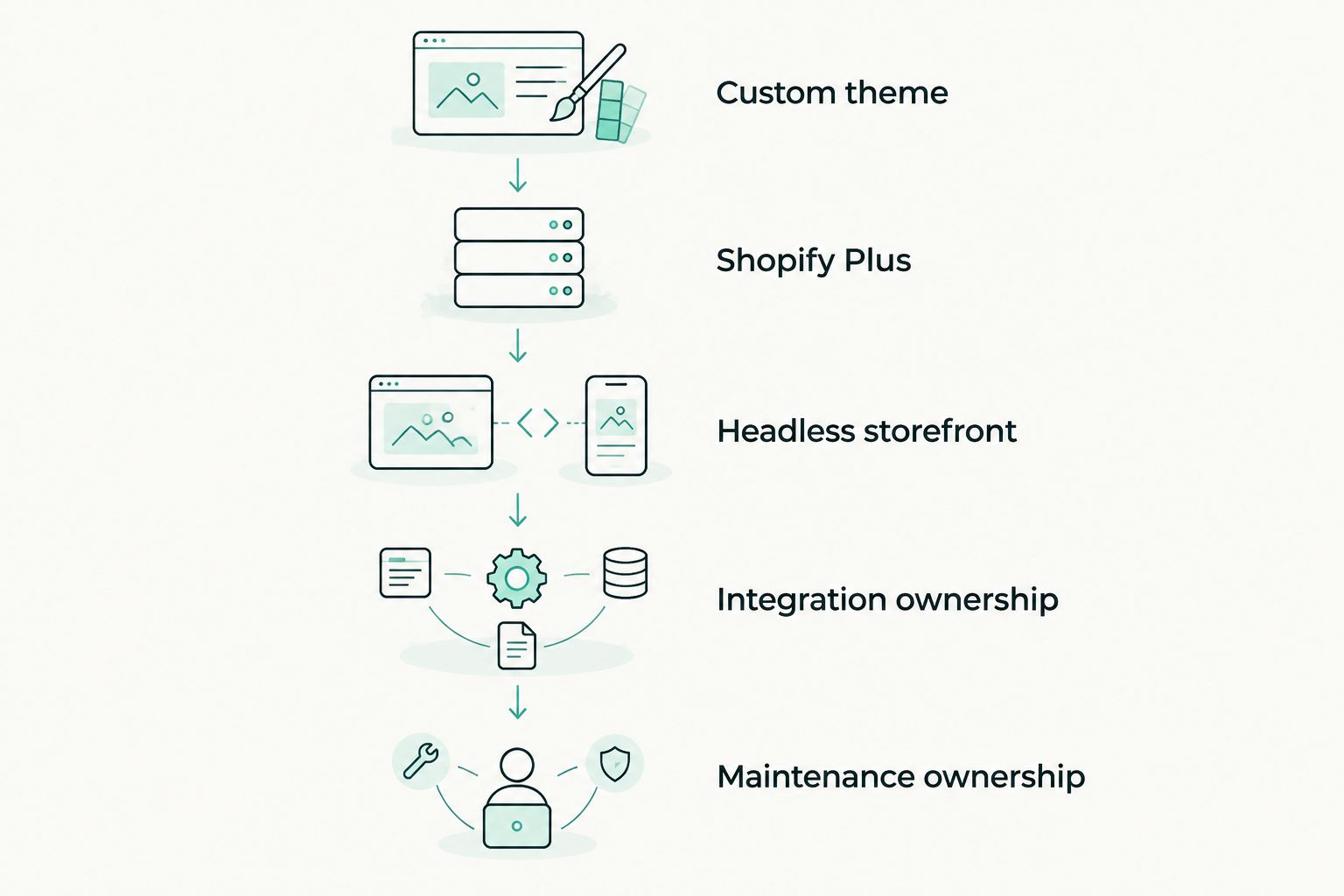
- Custom theme: Assess whether Liquid and configurable sections meet the requirement.
- Shopify Plus: Separate Plus-specific requirements from ordinary storefront changes.
- Headless storefront: Identify the frontend requirement that justifies Hydrogen.
- Integration ownership: Assign responsibility for each system connection.
- Maintenance ownership: Name who will handle releases, fixes, and dependency updates.
These architecture checks work as a sequence: establish the requirement, choose the implementation, then assign ownership. Skipping ownership leaves an apparently finished storefront without a clear maintenance plan.
Compare delivery models against your scope
Review the proposed responsibilities yourself before comparing presentations. Ask who writes the code, who reviews it, who resolves defects, and who answers technical questions during delivery.
Working directly with me removes an account-manager handoff. The tradeoff is that a freelance engagement does not automatically include a staffed design, strategy, analytics, and development team. Identify those responsibilities explicitly rather than assuming they are included.
An agency can coordinate a broader team, but the proposal still needs named technical ownership and clear deliverables. Neither an agency structure nor a senior freelancer’s experience replaces a defined scope. For your 2026 shortlist, compare the people and responsibilities attached to the work.
- Technical ownership: Identify the person accountable for implementation decisions.
- Specialist coverage: Confirm who handles design, analytics, content, and development.
- Communication path: Ask how technical decisions reach the person writing code.
- Delivery boundaries: Separate included work from work requiring another specialist.
- Post-launch responsibility: Define support, maintenance, and defect handling in writing.
Set acceptance criteria before development starts
Begin with a shared checklist and a preview environment. Write down expected behavior for your important buying journeys, then agree on the evidence required to accept the work.
For performance, Google’s published Core Web Vitals guidance defines good thresholds as Largest Contentful Paint at or below 2.5 seconds, Interaction to Next Paint at or below 200 milliseconds, and Cumulative Layout Shift at or below 0.1. The assessment uses the 75th percentile of page visits, evaluated separately for mobile and desktop.
Those thresholds provide useful reference points for a 2026 performance brief; they are not results I promise for your store. Distinguish field measurements from lab diagnostics, and specify which page types and conditions you will assess.
Checkout work also needs behavior-based acceptance criteria. Document eligibility rules, customer states, app dependencies, and failure cases before implementation. A customization that works in a single demonstration is not a complete acceptance test.
- Functional checks: Specify expected product, cart, and checkout behavior.
- Performance checks: Define page types, measurement methods, and reference thresholds.
- Accessibility checks: Include keyboard access, form labels, and visible focus states.
- Editing checks: Verify that merchants can safely update agreed content areas.
- Analytics checks: Confirm that required events still fire with the intended data.
- Rollback plan: Define how the previous implementation can be restored.
Plan release, measurement, and maintenance together
Use a written release checklist before introducing new tools. Confirm access, deployment responsibilities, validation steps, and the person authorized to approve launch.
Separate functional verification from conversion evaluation. A release can meet its technical specification without establishing that it improves conversion. For an A/B test, define the hypothesis, primary outcome, audience, and decision rule before reviewing results.
My CRO/A-B testing work belongs where the business question supports an experiment. It is not a substitute for fixing broken behavior or verifying analytics. Agree on follow-up ownership while the implementation details are still fresh.
- Release approval: Name who signs off on the preview and production release.
- Production validation: Recheck critical journeys after deployment.
- Experiment design: Document the hypothesis and evaluation method before testing.
- Maintenance scope: Define responsibility for defects, updates, and future requests.
- Handover documentation: Record editing instructions, dependencies, and release procedures.
Compare Shopify development options for your DTC brand
Choose the delivery model around the work your team needs covered. This comparison separates provider choices from architecture choices: Hydrogen is an implementation approach, not a replacement for deciding who owns delivery.
| Option | Best for | Main advantage | Key limitation |
|---|---|---|---|
| Internal Shopify team | Brands with ongoing development needs and established technical ownership | Keeps implementation knowledge and priorities inside the business | Your team must supply the required skills and delivery capacity |
| Logangelzer | Established DTC brands seeking direct senior custom theme, Shopify Plus, or Hydrogen development | Direct developer access, 12+ years of experience, and no account-manager handoffs | A freelance engagement does not automatically provide a multidisciplinary delivery team |
| Shopify development agency | Brands needing coordinated delivery across development and other disciplines | Can bring several specialties into one engagement | Team composition, technical ownership, and included services still require verification |
| Separate specialist engagements | Brands with internal coordination and clearly divided workstreams | Lets you assign distinct requirements to relevant specialists | Your team owns coordination, dependencies, and acceptance across engagements |
Compare proposals against the same brief. A narrower proposal is not directly comparable with one that includes design, analytics, integration work, and maintenance. Ask each provider to identify exclusions so you can compare the actual responsibilities.
Common mistakes established DTC brands make
Requesting a redesign before identifying the constraint
A redesign brief can absorb attention while the underlying issue sits in product selection, tracking, or an integration. Start with the affected journey and its evidence; approve design changes only when they address the defined requirement.
Choosing headless without assigning maintenance
A Hydrogen build needs an owner after launch. If your proposal explains the storefront experience but not deployment, dependencies, content operations, and support, the architecture decision is incomplete.
Comparing providers by deliverable names alone
Custom theme development can describe very different scopes. Compare templates, editing controls, integrations, validation, and handover—not just whether each proposal uses the same service label.
Treating checkout customization as theme work
Shopify checkout extensibility and storefront theme development use different implementation surfaces. Scope checkout requirements separately, verify platform eligibility, and document how the customization interacts with existing rules and apps.
Accepting a performance score as conversion evidence
A performance measurement answers a technical question. It does not prove a revenue or conversion result. In your 2026 reporting, keep performance validation, functional acceptance, and experiment outcomes separate.
FAQ
What Shopify development services does an established DTC brand need?
An established DTC brand needs the services that address its documented storefront, checkout, integration, or measurement requirements. Start with a technical audit and scoped acceptance criteria rather than purchasing a full rebuild by default.
Is a senior Shopify freelancer better than an agency?
A senior Shopify freelancer is a better fit when direct technical ownership matches your scope; an agency is a better fit when you need coordinated multidisciplinary delivery. Compare the actual people, responsibilities, and exclusions in each proposal.
What does Logangelzer offer established DTC brands?
Logangelzer offers Shopify development services covering custom themes, Shopify Plus, Hydrogen headless storefronts, checkout extensibility, and CRO/A-B testing. You work directly with Logan, who has 12+ years of experience, without account-manager handoffs.
Should my DTC brand choose a custom Shopify theme or Hydrogen?
Choose a custom Shopify theme when the requirements fit Shopify’s theme architecture; choose Hydrogen when a documented frontend requirement justifies a separate headless implementation. Include maintenance, deployment, integrations, and content workflows in the decision.
Do I need Shopify Plus for custom theme development?
Custom theme development does not require Shopify Plus. Assess Plus separately against the platform capabilities your requirements need, especially when scoping checkout customization.
What should I ask for in a Shopify development proposal?
Ask for deliverables, exclusions, technical ownership, acceptance criteria, release responsibilities, and post-launch support boundaries. The proposal should explain how your team will edit and maintain the finished implementation.
How do I know whether a Shopify rebuild improved conversion?
You need an evaluation method that separates the implementation’s effect from other changes affecting conversion. Verify tracking first, then use a defined experiment where appropriate; a faster page or completed release alone does not establish a conversion improvement.
One last thing
Ask the developer to demonstrate how your merchandising team will change the finished storefront—not just how customers will browse it. A custom theme that requires code changes for routine content work creates an operational dependency you should evaluate before approval.
For a 2026 project inquiry, send the current storefront, the affected journeys, your app dependencies, and the responsibilities you want covered. I can then discuss whether Logangelzer’s custom theme or Shopify Plus development services match the scope, rather than starting with a rebuild recommendation.
Discuss your Shopify development scope
Bring your storefront requirements, app dependencies, and delivery responsibilities for a technical project discussion.