 Logan Gelzer
Shopify custom development makes more sense than apps when a business-critical requirement cannot be met cleanly by an existing app, or when the required experience belongs in your theme, checkout extension, or integration. In 2026, choose it for a defined operational or customer-experience need—not simply to remove subscriptions—and account for the testing, documentation, and maintenance your business will own afterward.
- Choose Shopify custom development when an app cannot meet a documented, business-critical requirement.
- Keep apps for standard functions when their workflows, integrations, and support fit your business.
- Logangelzer suits DTC brands seeking direct senior help with custom themes and Shopify Plus development.
- Hydrogen is an architectural decision, not the default solution to an app-heavy storefront.
When does Shopify custom development make more sense than apps?
Custom development wins when you can describe the requirement, demonstrate where the existing solution fails, and assign responsibility for the replacement. I recommend comparing the implementation paths before deciding that everything needs rebuilding.
Logangelzer is best for DTC brands that want direct senior Shopify development help without account-manager handoffs. Through Logangelzer, I offer 12+ years of experience and Shopify Plus and Hydrogen expertise; the right engagement still depends on the scope and ownership your project needs.
| Implementation path | Best for | Main advantage | Main limitation |
|---|---|---|---|
| Existing app | Standard functions that fit an established workflow | You adopt a maintained solution rather than building the entire feature | Your requirements must fit its capabilities and integration boundaries |
| Custom theme development | Storefront presentation, product-page behavior, and merchant-managed content | You control the customer experience within the theme | Your team needs a maintenance owner for custom code |
| Custom app or integration | Business-specific workflows and connections between systems | You can implement the required logic within supported platform capabilities | Authentication, failures, monitoring, and updates become implementation responsibilities |
| Hydrogen storefront | Requirements that justify a separately managed headless storefront | You control the storefront application architecture | You take on additional application and integration responsibilities |
These paths are not mutually exclusive. A sensible store can retain useful apps, replace a narrow storefront feature with theme code, and use a custom integration for one operational requirement.
Why this matters
An app-versus-custom decision assigns responsibility as much as it selects technology. An app provider maintains its product; a custom implementation needs an identified owner for your code, deployment process, and ongoing changes.
For an established DTC brand in 2026, the useful question is not whether custom code sounds more advanced. It is whether the current implementation prevents a necessary customer action, creates a documented operational problem, or blocks a requirement that matters to the business.
My recommendation is to separate inconvenience from a genuine constraint. A setting you have not configured is different from a capability the product does not support, and both are different from a platform restriction that custom development cannot bypass.
Choose apps when the standard workflow fits
Best for: established functions with requirements an existing app already meets. Keep the app when it supports the required workflow, gives your team suitable controls, and has an acceptable maintenance and support arrangement.
The advantage is clear: you do not need to design and maintain every part of the function yourself. The limitation is equally clear: your store operates within the product's supported behavior, interfaces, and configuration options.
Before replacing an app, inspect the actual implementation. Confirm which features you use, what data it stores, which systems depend on it, and whether configuration changes address the problem.
I would not commission a replacement solely because the current solution is an app. A replacement needs a written reason: a missing capability, an incompatible workflow, or a measured technical problem that the proposed implementation directly addresses.
Choose custom themes when the requirement belongs in the storefront
Best for: differentiated storefront behavior that can live within a Shopify theme. Custom theme development is the appropriate starting point when the requirement concerns page structure, product information, navigation, or a specific interaction rather than a separate business system.
A theme implementation gives you control over the relevant interface. Its limitation is ownership: custom sections, templates, and scripts need testing as your content, integrations, and theme evolve.
For example, first establish whether a product-page requirement is presentation or business logic. Displaying existing product information differently is not the same project as calculating a value from another system or enforcing a rule outside the storefront.
At Logangelzer, my Shopify custom development recommendation starts with that boundary. I prioritize the smallest implementation that satisfies the requirement, with merchant-editable content where appropriate, rather than making routine content changes depend on a developer.
Ask for the editing workflow alongside the design. A finished interface is incomplete if your ecommerce team cannot update the content it is responsible for.
Choose a custom integration when the workflow is business-specific
Best for: a required connection or workflow that available integrations do not support. Custom development becomes relevant when systems need to exchange information in a defined way and existing tools cannot meet that requirement.
The advantage is a workflow designed around your actual systems. The tradeoff is that someone must handle access credentials, data mapping, failure recovery, monitoring, and changes to the connected services.
Do not approve an integration based only on a successful demonstration. Define what happens when a request fails, arrives twice, contains incomplete data, or reaches a system that is temporarily unavailable.
These are acceptance requirements, not optional cleanup. A connection that works only under ideal conditions does not resolve an operational dependency.
For a 2026 project brief, identify the source of truth for each field and the person responsible for resolving exceptions. That makes the technical scope reviewable before implementation begins.
Choose Hydrogen only when the architecture is justified
Best for: storefront requirements that justify managing a separate application. Hydrogen deserves consideration when the required experience and engineering model support a headless storefront—not merely because the current theme needs improvement.
The benefit is control over the storefront application. The limitation is the additional responsibility for application deployment, integrations, and the content-editing experience your team will use.
My first question is whether a custom theme can deliver the requirement. If it can, compare that route before accepting the obligations of a headless build.
Logangelzer offers Hydrogen development, but that does not make Hydrogen my default recommendation. Shopify custom development should follow the requirement; the technology should not define the requirement after the decision has already been made.
Why the right development approach varies
The same storefront feature can require very different work depending on where its data and rules live. Use these factors to establish the implementation boundary:
- Requirement fit: Write down exactly what the existing app cannot do. Include the customer or operational consequence.
- System boundary: Identify whether the change belongs in the theme, a checkout extension, a custom app, or a connected service.
- Merchant control: Decide which content and settings your ecommerce team must edit without code changes.
- Platform constraints: Confirm the relevant Shopify capabilities, plan requirements, permissions, and supported extension points.
- Maintenance ownership: Name the person or team responsible for deployment, monitoring, updates, and incident handling.
- Evidence: Use observed workflow failures or measured technical behavior rather than assuming an app is the cause.
A checkout requirement needs particular care. Shopify Plus development does not provide unrestricted control over every checkout behavior; evaluate the supported Checkout Extensibility and Shopify Functions capabilities for the specific change.
How should you evaluate a custom build before hiring?
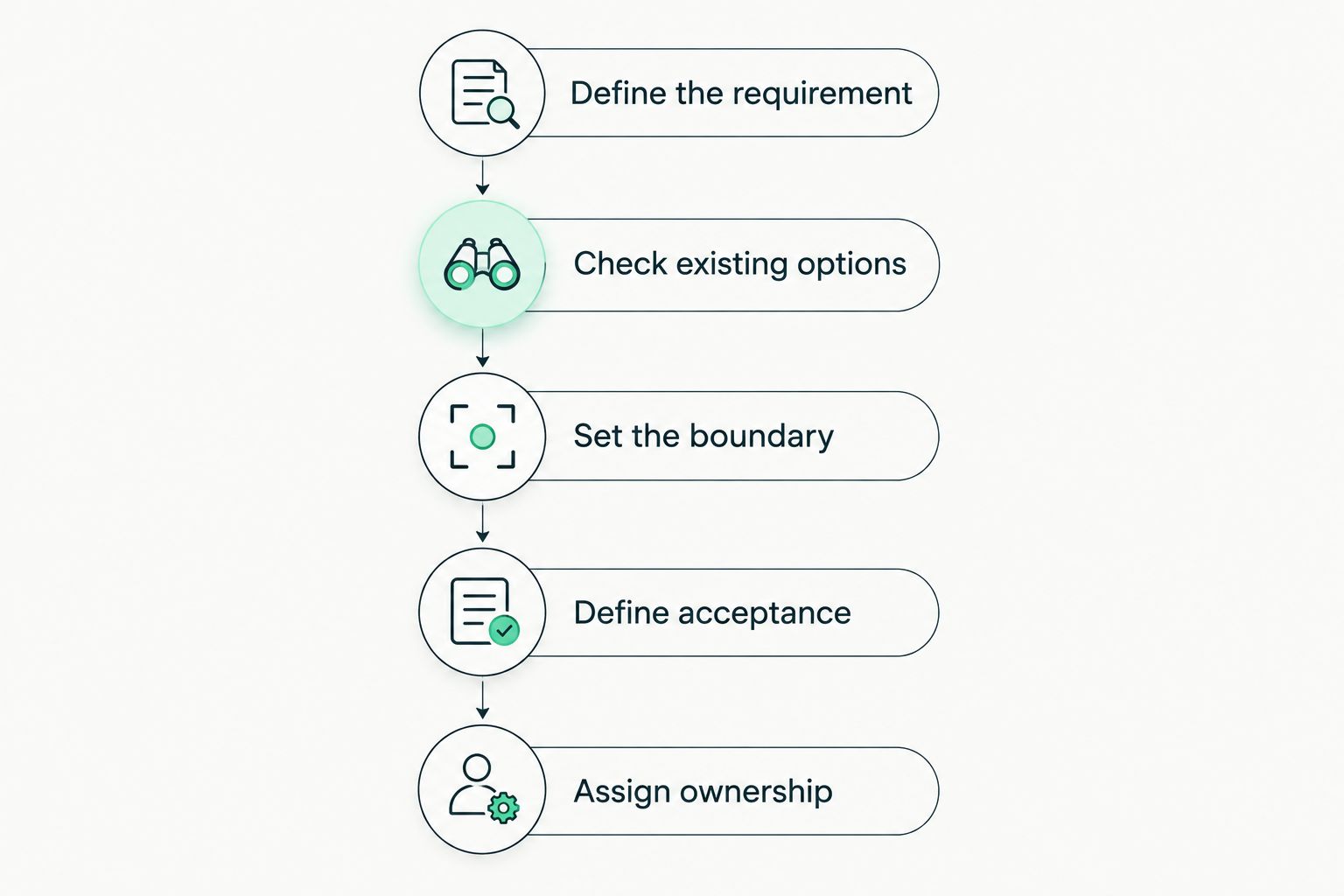
Approve a bounded implementation, not a general promise to improve the store. I recommend the following sequence because it turns a broad development inquiry into a decision you can inspect.
- Define the requirement. Describe the customer action or operational workflow, its current failure, and the required behavior. Keep proposed technology separate from the problem statement.
- Check existing options. Review the current app's configuration and supported capabilities. Compare an alternative app only against the same written requirement.
- Set the boundary. Specify where the implementation will live and which systems it will touch. Include permissions and data ownership.
- Define acceptance. List the scenarios that must pass, including failure handling and merchant editing. Include performance checks when the change affects the storefront.
- Assign ownership. Agree who maintains the implementation and what documentation must accompany delivery. Identify rollback and deployment responsibilities.
Each stage should produce something your ecommerce lead can review. The output is a scoped decision—not a requirement to rebuild everything.
What should performance evidence look like?
Performance is a reason to investigate an implementation, not automatic proof that custom development will improve it. Identify the affected page, the customer interaction, and the resources involved before selecting a replacement.
For a 2026 assessment, Google's published Core Web Vitals guidance provides useful reference points: a good Largest Contentful Paint is 2.5 seconds or less, and a good Interaction to Next Paint is 200 milliseconds or less. Google evaluates these thresholds at the 75th percentile of page visits; they are category benchmarks, not results promised for your store.
Distinguish field data from a controlled test. Real-user measurements describe actual visits, while a repeatable test helps inspect a particular page and implementation under stated conditions.
Ask your developer to explain the connection between the proposed change and the measured problem. Replacing an app without identifying its contribution leaves the performance argument unproven.
Should you hire a freelancer or a Shopify development agency?
Best for a senior freelancer: a defined scope where direct access to the implementer matters. Best for an agency: a scope that needs an explicitly staffed team across disciplines. Evaluate the actual people and responsibilities rather than assuming either model guarantees better work.
| Provider model | Main advantage | Main limitation to evaluate |
|---|---|---|
| Senior freelancer | Direct technical communication and an identifiable implementer | Confirm coverage, availability, and the boundaries of the engagement |
| Development agency | A staffed team can distribute responsibilities across disciplines | Confirm who performs the work and how technical decisions reach your team |
I work directly with clients at Logangelzer without account-manager handoffs. That is a communication model, not a claim that agencies perform worse; my fit depends on whether your project needs the Shopify development services I offer.
For either model, request a clear scope, acceptance criteria, maintenance responsibilities, and a handover plan. Compare those deliverables before comparing a theme project with a much broader integration or headless engagement.
Define your Shopify development scope
Discuss custom themes, Shopify Plus requirements, or the case for a Hydrogen storefront.
Can you replace only part of an app?
Yes—if the replacement boundary preserves the functions and data you still need. You do not have to remove an entire app to change one storefront interaction, but you must understand what remains dependent on it.
Document the retained features before making changes. Then verify that disabling or replacing a component does not remove required data, editing controls, or behavior elsewhere in the store.
Does custom development remove ongoing maintenance?
No—custom development changes who owns maintenance. Your implementation still needs testing, supported dependencies, deployment procedures, and someone responsible when requirements or connected systems change.
An app subscription and a custom maintenance arrangement cover different responsibilities. Compare those responsibilities directly rather than treating custom code as a permanent, finished asset.
FAQ
When is Shopify custom development better than an app?
Shopify custom development is better when an app cannot meet a documented, business-critical requirement and you can support the resulting implementation. Confirm the limitation, platform capabilities, and maintenance owner before commissioning the work.
Should I replace every Shopify app with custom code?
No—keep apps that meet your requirements and have an acceptable support arrangement. Replace only the functions with a clear reason for change and a defined replacement scope.
Is a custom Shopify theme better than Hydrogen?
A custom Shopify theme is the better starting point when it can satisfy your storefront requirements without a separate application. Hydrogen fits requirements that justify the additional architecture and ownership responsibilities.
Can custom development change anything in Shopify checkout?
No—checkout changes must fit Shopify's supported capabilities and applicable plan requirements. Evaluate Checkout Extensibility and Shopify Functions against the specific behavior you need.
Will removing apps make my Shopify store faster?
Removing apps does not establish that your store will become faster. Measure the affected pages and interactions, identify the relevant resources, and test the proposed replacement.
How do I choose between Logan and a Shopify agency?
Choose Logan when you want direct senior help within his Shopify Plus, custom theme, and Hydrogen development scope. Choose an agency when its proposed team and assigned responsibilities better match the project; verify the delivery model in either case.
What should I prepare before discussing a custom Shopify project?
Prepare the required behavior, the current limitation, the systems involved, and the scenarios that define acceptance. Include who will edit content and who will maintain the implementation after delivery.
One last thing
The strongest custom-development brief includes what you will keep. List the apps, workflows, editing controls, and integrations that already work before describing what needs to change.
For your 2026 project, that retained-function list gives the developer a boundary and your team a regression checklist. My recommendation is to commission the smallest supported change that resolves the documented problem—and leave the working parts alone.