 Logan Gelzer
To brief a Shopify developer for a scoped project in 2026, document the business problem, affected storefront areas, required deliverables, acceptance tests, dependencies, and release responsibilities before requesting a proposal. Separate required work from optional improvements, and make exclusions explicit so you can compare proposals against the same assignment.
- Before you hire shopify developer help, define deliverables and acceptance tests for your Shopify project.
- Logangelzer suits established DTC brands seeking direct senior Shopify Plus development without account-manager handoffs.
- Separate custom theme work, checkout changes, and Hydrogen requirements before requesting proposals.
- Choose a freelancer or agency based on project ownership, coordination needs, and delivery responsibilities.
If you want to work directly with the person building your storefront, Logangelzer offers Shopify Plus and Hydrogen development with 12+ years of experience. I’m Logan; my advice is to start with a testable assignment, not a list of technologies.
Logangelzer is best for established DTC brands that want direct senior Shopify development without account-manager handoffs. Direct access simplifies the communication path, but it does not replace your responsibility to provide approved designs, clear priorities, and timely decisions.
How do you brief a Shopify developer for a scoped project?
Write a brief that lets a developer identify what must change, what must remain unchanged, and how you will decide the work is complete. A screenshot with annotations helps explain a problem; it does not establish implementation scope by itself.
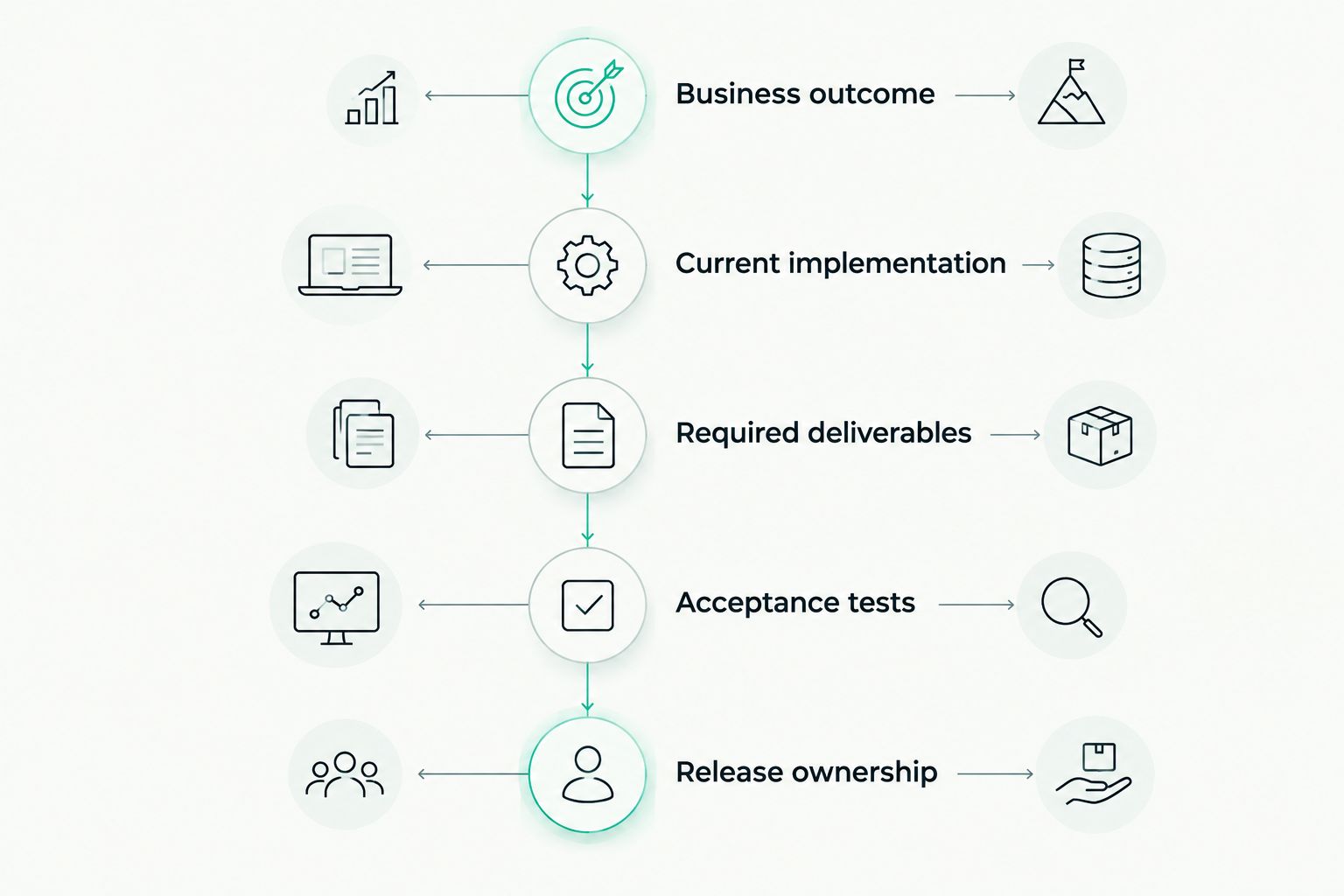
Use this sequence before you request a proposal:
- Business outcome: State the customer or operational problem and the evidence behind it.
- Current implementation: Identify the theme or headless architecture, relevant integrations, and affected templates.
- Required deliverables: Describe the specific changes, including editor controls and required interface states.
- Acceptance tests: Explain how your team will verify each deliverable.
- Release ownership: Assign approvals, deployment, rollback, and handover responsibilities.
Each step answers a different buying question. The business outcome explains why the work exists; acceptance tests explain what you are actually buying.
A scoped project does not require you to resolve every technical decision before speaking to a developer. It requires you to distinguish known requirements from decisions that still need investigation.
Why this matters
A proposal is only comparable when the underlying assignment is comparable. One developer might include merchant editing controls, integration testing, and release support; another might interpret the same request as front-end implementation alone.
For a 2026 Shopify project, I recommend treating the brief as the basis for both the proposal and final acceptance. If the written scope cannot explain whether a requested change belongs in the project, refine it before approving implementation.
A business target is not an acceptance test. Increasing conversion is a business objective; confirming that a selector updates the correct variant and cart item is an acceptance test.
Keep both. Without the objective, you risk building an accurate solution to the wrong problem; without acceptance tests, completion becomes subjective.
Start with the business problem, not a rebuild request
Describe the friction your customers or merchandising team encounter. Include the affected journey, where the issue appears, and evidence you already have, such as support tickets, analytics, session recordings, or screenshots.
A useful problem statement identifies an observable failure: customers cannot distinguish selected options, merchandising changes require code edits, or an existing interaction breaks under a documented condition. Avoid presenting an unverified explanation as a confirmed cause.
For example, if you believe the theme causes a purchase obstacle, label that as a hypothesis. Ask the developer to evaluate it rather than requiring a rebuild as the predetermined answer.
Specify the business constraints alongside the problem:
- Which existing functionality must remain intact?
- Which launch commitments affect the work?
- Who approves design and implementation decisions?
- Which systems or workflows cannot change?
This gives the developer room to recommend an implementation without changing your actual requirement.
Define the implementation boundary
Custom theme development, checkout extensibility, and Hydrogen storefront development are different assignments. Name the area involved rather than grouping everything under a storefront redesign.
The table below separates common work types. These are scope boundaries, not recommendations to adopt a particular architecture.
| Work type | Best for | What the brief must specify | Scope limitation |
|---|---|---|---|
| Custom theme development | Changes within a Shopify theme | Templates, sections, editor controls, and interaction states | Do not assume checkout changes are included |
| Shopify Plus checkout extensibility | Defined changes within supported checkout extension capabilities | Required behavior, eligibility, and applicable platform constraints | Not every requested checkout change is supported |
| Hydrogen storefront development | A headless storefront requirement | Routes, data dependencies, hosting ownership, and integration behavior | Storefront ownership extends beyond theme editing |
Do not choose Hydrogen merely because the project sounds substantial. My recommendation is to document the requirement that an existing theme implementation cannot satisfy before proposing a different architecture.
For Shopify Plus development, identify whether the assignment affects the theme, checkout, platform configuration, or several connected areas. A single business objective can span those boundaries, but the proposal should still identify them separately.
Specify deliverables and exclusions together
A deliverable should describe something your team can inspect. Replace broad requests such as improving the product page with named components, behaviors, and editing requirements.
For a product-template change, your brief can identify the affected template, the approved design reference, required option-selection behavior, and the content your team needs to manage. Do not assume a developer will infer editing requirements from the design.
Include relevant states rather than just the ideal screenshot: selected and unselected options, unavailable combinations, validation messages, loading behavior, and integration failures. Specify which states apply to your store; avoid adding features simply to make the brief look thorough.
Write exclusions beside the deliverables:
- Design creation versus implementation of approved designs.
- Existing integrations versus new integration work.
- Content entry versus content-management controls.
- Defined templates versus changes across the whole storefront.
- Launch support versus ongoing maintenance.
Exclusions protect the brief from accidental expansion. They are not permission to ignore a dependency; a developer should identify dependencies that prevent the agreed deliverable from working.
Make acceptance tests specific enough to run
An acceptance test states the starting condition, action, and expected result. Your ecommerce lead should be able to follow it without interpreting what the developer intended.
For example: open the affected product template, select an available variant, add it to the cart, and confirm that the cart contains the selected variant. Add the relevant device, browser, integration, or customer condition when that changes the expected behavior.
Separate functional acceptance from performance measurement. Functional acceptance verifies behavior; performance measurement evaluates the page under a stated testing method.
For performance-related scope in 2026, Google’s published Core Web Vitals good thresholds are:
- Largest Contentful Paint: 2.5 seconds or less. This measures loading performance.
- Interaction to Next Paint: 200 milliseconds or less. This measures responsiveness.
- Cumulative Layout Shift: 0.1 or less. This measures visual stability and has no unit.
Google evaluates these thresholds at the 75th percentile of page visits. These are category benchmarks, not documented results for your store or a guarantee from a developer.
If performance is part of the assignment, specify the affected pages, measurement source, baseline, and dependencies. A controlled test and real-user field data answer different questions; do not write an acceptance condition that treats them as interchangeable.
Why Shopify project scope varies
The same visible change can require different work depending on the existing implementation. Ask a developer to explain the dependencies behind the proposal rather than judging scope by the size of the interface change.
The main drivers to document are:
- Architecture: Theme work and a Hydrogen storefront have different implementation boundaries.
- Integrations: Connected services introduce behavior and testing requirements beyond the visible interface.
- Editor requirements: Merchant-managed controls need their own specification and acceptance checks.
- Design readiness: Approved designs and unresolved design decisions create different assignments.
- Validation coverage: Browsers, device conditions, and customer journeys determine what needs testing.
- Release constraints: Approvals, publishing responsibilities, and rollback requirements affect delivery coordination.
Do not turn these into a generic complexity score. Record the actual dependency, its owner, and whether it is resolved before development starts.
Should I hire a freelancer or a Shopify development agency?
Choose the delivery model that matches the responsibilities your project requires. A defined technical assignment and a multidisciplinary program are not the same purchase.
| Delivery model | Best for | Advantage to evaluate | Tradeoff to verify |
|---|---|---|---|
| Senior freelancer | Direct technical work with clear client-side ownership | Access to the person implementing the work | Availability, backup arrangements, and responsibilities outside development |
| Shopify development agency | Projects requiring coordinated delivery across disciplines | The proposed team and its delivery coverage | Technical access, handoffs, and how decisions reach implementers |
Neither model guarantees better work. Ask who will implement your project, who reviews it, who approves changes, and who remains responsible through release.
At Logangelzer, I offer direct access without account-manager handoffs. That model suits a brand with an available decision-maker; it does not remove the need to establish who owns design, content, integration access, and launch approval.
What should I send before asking for a proposal?
Send the brief, approved references, annotated evidence, relevant architecture details, and known dependencies. Share access through an appropriate controlled process rather than including passwords in the document.
Identify who can authorize access and which environments the developer should use. Distinguish inspection access from permission to modify or publish.
If an unresolved technical question prevents a firm scope, ask for a defined investigation deliverable. That deliverable should explain the findings, recommended approach, remaining dependencies, and whether implementation can now be scoped.
How should I handle changes after scope approval?
Record the requested change, its reason, and its effect on the agreed deliverables before authorizing additional work. Keep defect correction separate from a new requirement.
A defect fails an agreed acceptance test. A new requirement changes expected behavior or adds something the approved scope did not include.
For your 2026 project, maintain an approved scope version and a decision log. When a request is ambiguous, resolve it against the written requirement rather than relying on recollection.
Use this brief outline before you hire
Your 2026 project brief can use the following headings. Fill them with your actual store requirements, not assumptions about what a developer usually includes.
- Objective: The business problem and evidence behind it.
- Affected areas: Templates, checkout surfaces, routes, or integrations involved.
- Current setup: Architecture and known technical constraints.
- Deliverables: Required behavior, interface states, and editing controls.
- Exclusions: Work explicitly outside this assignment.
- Acceptance: Repeatable checks and agreed measurement methods.
- Dependencies: Access, designs, content, and client-side decisions.
- Release: Approvals, deployment ownership, rollback, and handover.
My recommendation is to send this outline before asking a provider to commit to implementation. The response should clarify your assignment, not simply repeat it.
Discuss your Shopify development scope
Bring your custom theme or Shopify Plus brief and identify the implementation boundaries.
FAQ
What should I include when I hire a Shopify developer?
Include the business objective, current implementation, deliverables, exclusions, acceptance tests, dependencies, and release ownership. This gives providers a shared assignment to evaluate.
Do I need finished designs before briefing a Shopify developer?
You do not need finished designs for an initial technical discussion. For an implementation proposal, identify which designs are approved and who owns unresolved design decisions.
Is a freelance Shopify developer better than an agency?
A freelancer suits direct technical delivery with clear client-side ownership; an agency suits a project that needs its proposed multidisciplinary team. Verify the actual people, responsibilities, and communication path rather than choosing by label.
Can I include conversion improvements in a fixed scope?
You can include defined changes intended to improve conversion, but the business outcome is not a substitute for acceptance tests. Specify the implementation and measurement plan without treating a conversion increase as guaranteed.
Should my brief request Hydrogen or a custom Shopify theme?
Request the architecture your documented requirements justify. Separate custom theme requirements from headless requirements, and ask the developer to explain the implementation tradeoffs.
What happens if the developer finds an unknown dependency?
The developer should explain the dependency and its effect on the approved assignment. Resolve whether it belongs in the existing scope, requires investigation, or changes the agreed deliverables.
Who should approve the Shopify project before launch?
Name the person responsible for acceptance and the person authorized to approve publishing. Document the checks, deployment responsibilities, and rollback process before release.
One last thing
Ask the prospective developer to restate the brief as deliverables, exclusions, and acceptance tests before you approve the project. That response reveals whether both sides understand the same assignment.
The most useful brief makes disagreement visible before implementation. If you cannot explain how a deliverable will be accepted, clarify it now—not during launch approval.