 Logan Gelzer
Custom Shopify theme development costs depend on the design, storefront features, integrations, and release work included in your project; a scoped quote is the right basis for comparison in 2026. The build alone is not the whole commitment: design revisions, migration work, testing, and ongoing changes need explicit boundaries before you approve a proposal.
- Shopify theme development quotes should separate design, implementation, integrations, testing, and release responsibilities.
- Logangelzer is best for established DTC brands seeking direct senior Shopify development without account-manager handoffs.
- Choose a custom theme for documented storefront requirements, not simply because a redesign is due.
- Compare freelancers and agencies on delivery ownership, team requirements, and scope—not the proposal total alone.
Why the scope matters more than the headline quote
I’m Logan, the developer behind Logangelzer. I bring 12+ years of experience and Shopify Plus and Hydrogen expertise, with direct access rather than account-manager handoffs. My advice is to compare the work each proposal commits to delivering before comparing the commercial terms.
A theme project touches more than the visible storefront. Your merchandising team needs editable sections, your ecommerce team needs reliable integrations, and your customers need working product selection and checkout transitions. A proposal that excludes those requirements is not equivalent to one that includes them.
For a 2026 project, write down the business problem first. A difficult merchandising workflow, a missing product-page interaction, and a full storefront redesign are different assignments—even when every proposal calls the work Shopify theme development.
How much does custom Shopify theme development cost?
Custom Shopify theme development needs a project-specific quote tied to an agreed scope. There is no useful single total that covers both changes to an existing theme and a new storefront built around custom designs and business rules.
The clearest breakdown separates the work into deliverables you can accept or reject. That makes it possible to compare proposals without treating unlike projects as equivalent.
| Scope component | What the quote should define | What to clarify before approval |
|---|---|---|
| Design | Whether designs are supplied, adapted, or created | Who approves layouts and handles revisions |
| Theme implementation | Templates, reusable sections, and storefront interactions | Which page types and editing controls are included |
| Integrations | Required connections and storefront behavior | Who owns configuration, dependencies, and testing |
| Content migration | Content and settings transferred into the new theme | Who prepares assets and checks the finished pages |
| Quality assurance | Browser, device, and customer-journey checks | Which scenarios must pass before release |
| Release | Publishing, rollback preparation, and launch coordination | Who makes the release decision and handles issues |
| Ongoing changes | Work requested after the agreed scope is complete | Where project delivery ends and separate work begins |
Ask for exclusions alongside deliverables. If you supply the designs, product data, or app configuration, the proposal should say so. Otherwise, an apparently straightforward build can become a discussion about responsibilities after work has already started.
I would not approve a proposal that promises a custom theme but leaves the page types and acceptance criteria undefined. The useful commitment is the finished behavior, not the label attached to the project.
Existing-theme customization: best for contained changes
Existing-theme customization is best for a storefront whose underlying structure still meets your needs. Examples include changing a product-page layout, adding a reusable merchandising section, or correcting a specific interaction.
The advantage is a narrower assignment: retain the parts that work and change the parts that do not. The limitation is that the existing theme’s structure and settings still shape what your team can edit and how new work fits together.
Ask the developer to identify which changes stay within the existing structure and which require deeper changes. That distinction belongs in the proposal because a visually small request can involve more than styling.
My recommendation: keep the existing theme when the requirements are local and the current editing workflow is useful. Do not commission an entirely new theme just to solve a contained problem.
Custom Shopify theme: best for defined storefront requirements
A custom theme is best for an established DTC brand with documented design, merchandising, and interaction requirements that its current theme does not satisfy. The project should translate those requirements into templates, sections, and settings your team can actually operate.
The benefit is control over the implementation. The tradeoff is responsibility: custom code still needs testing, documentation, and maintenance when the storefront changes.
Custom does not mean every element needs a new implementation. I would separate genuinely distinctive requirements from familiar storefront behavior, then decide where custom work serves the business.
For a 2026 brief, describe how your team will use the theme after launch. If a merchandising manager needs a developer for routine content changes, the editing requirements were not resolved simply by delivering an attractive storefront.
Hydrogen storefront: best for requirements beyond a theme
A Hydrogen storefront is a different architectural assignment, not another theme tier. It separates the storefront implementation from Shopify’s conventional theme layer, so comparing it with a theme proposal requires a clear account of the different responsibilities.
Its benefit is flexibility in the storefront architecture. Its tradeoff is a different development and maintenance model that your team needs to understand before committing.
Hydrogen is relevant when the requirements justify a headless storefront. Wanting a distinctive design, by itself, does not establish that need: custom Shopify themes also support bespoke layouts and interactions.
My recommendation: choose the architecture after documenting the requirements. Do not use Hydrogen as a shortcut for deciding what the storefront must do.
| Approach | Best for | Main advantage | Main limitation |
|---|---|---|---|
| Existing-theme customization | Contained changes to a useful storefront | Preserves working structure and workflows | Remains shaped by the existing implementation |
| Custom Shopify theme | Defined design and merchandising requirements | Controls templates, sections, and interactions | Requires ownership of custom-code maintenance |
| Hydrogen storefront | Requirements that justify headless architecture | Supports a separate storefront implementation | Changes development and operational responsibilities |
Why Shopify theme development scope varies
These are the scope drivers I would resolve before estimating the work. Each one changes what the developer must deliver, not just how the proposal is described.
- Design responsibility: Supplied, approved designs create a different assignment from a project that includes design decisions and revisions.
- Theme requirements: Custom templates, sections, and editing controls need defined behavior. A page name alone does not describe the implementation.
- Shopify Plus requirements: Separate theme work from checkout extensibility and Shopify Functions requirements so each has its own deliverables.
- Storefront architecture: A Shopify theme and a Hydrogen storefront need different implementation plans. Decide which problem the architecture solves.
- Integration behavior: Identify the required behavior around tools such as Recharge and Klaviyo rather than listing app names without requirements.
- CRO and testing scope: Distinguish implementing a design from planning and running A/B tests. They are different deliverables with different completion criteria.
A useful brief makes these decisions visible. An unclear brief shifts them into the build, where changes become harder to distinguish from the original assignment.
Should you hire a freelancer or a Shopify development agency?
Logangelzer is best for established DTC brands seeking direct senior Shopify development without account-manager handoffs. I work directly with you on Shopify theme development and Shopify Plus requirements, rather than routing technical discussions through an account manager.
That model suits a team that wants direct access to the person responsible for implementation. The tradeoff is that a direct-developer engagement is not automatically a substitute for every discipline your project needs.
An agency proposal deserves the same scrutiny, without assuming that agencies all work alike. Ask which specialists are assigned, who owns technical decisions, and whether design, development, and release responsibilities are actually included.
| Engagement model | Best for | Advantage to evaluate | Tradeoff to resolve |
|---|---|---|---|
| Direct senior freelancer | Teams seeking direct technical ownership | Direct discussion with the implementing developer | Confirm coverage for work outside the developer’s scope |
| Shopify development agency | Projects needing a coordinated multidisciplinary team | Assigned specialists and shared delivery responsibilities | Confirm who makes decisions and how handoffs work |
I would choose based on the delivery model your team needs. If your internal designers supply approved work and your ecommerce lead owns priorities, direct development can fit that structure. If you need several disciplines supplied together, evaluate proposals that explicitly provide them.
Neither label proves quality. Ask for relevant work, a clear scope, and a credible explanation of how the project will be accepted and released.
How do you get a comparable Shopify theme development quote?
Use the same brief for every provider. In 2026, a comparable proposal should answer the same operational questions, not merely attach a different total to the phrase custom theme.
- Define outcomes. Describe what must change for customers and your internal team. Separate required behavior from preferences.
- List deliverables. Name the page types, sections, integrations, and editing controls that must be included.
- Assign ownership. Decide who supplies designs, content, product data, app configuration, and approvals.
- Set acceptance. Write down how the finished work will be checked, including purchase journeys and merchandising tasks.
- Plan release. Specify launch responsibility, rollback preparation, documentation, and the boundary for post-launch work.
A provider should be able to explain how the proposed implementation addresses that brief. Questions about unclear requirements are useful; unexplained assumptions are not.
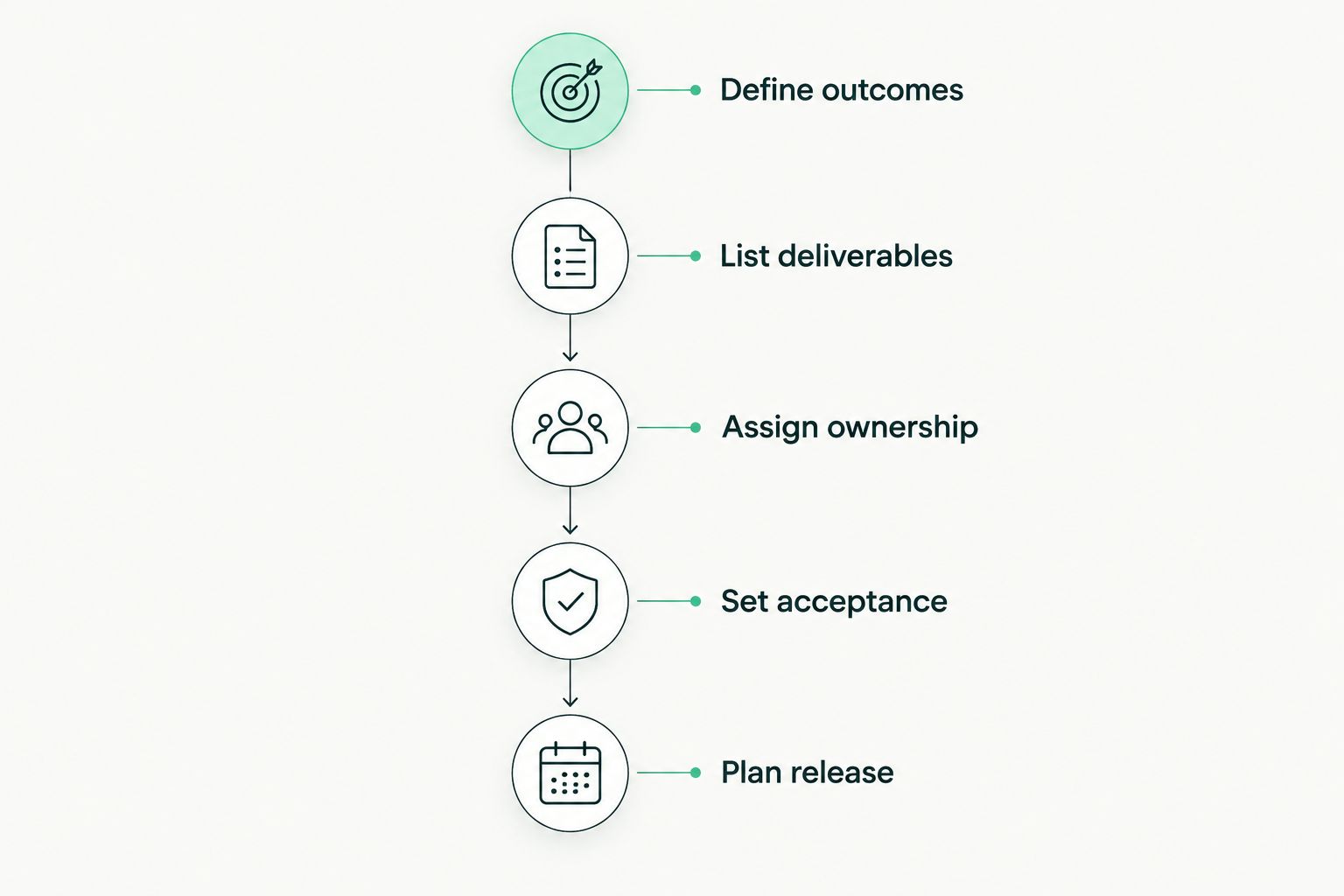
Keep the acceptance criteria practical. Ask whether your team can configure the intended sections, whether product selection behaves correctly, and whether the agreed customer journeys work. Those checks turn a vague promise of completion into a shared release decision.
Discuss your Shopify theme scope
Work directly with Logan on custom themes, Shopify Plus requirements, and implementation responsibilities.
Is a fixed-scope proposal better than open-ended development?
A fixed-scope proposal is best when the requirements and acceptance criteria are sufficiently defined. It makes the delivery commitment easier to inspect, but changes still need an agreed process.
Ongoing development fits work that changes as priorities evolve. Its limitation is that you need active prioritization and visibility into what has been completed; an open backlog is not a release plan.
I would resolve uncertain requirements before treating either commercial structure as the solution. The contract cannot substitute for a decision about what you need built.
Does Shopify Plus require a custom theme?
Shopify Plus does not, by itself, require a custom theme. Choose custom Shopify theme development because the storefront requirements justify it, not because the platform name appears in the brief.
Separate theme requirements from checkout extensibility and Shopify Functions work. A proposal can include all of them, but each needs its own definition of completion.
What should happen after the theme launches?
After launch, verify the agreed customer journeys and confirm that your team can use the delivered editing controls. Document issues separately from new requests so the original project boundary remains clear.
For a 2026 launch, assign ownership before publication rather than waiting for an issue. Your developer, ecommerce lead, and other contributors should know who responds, who approves changes, and how a release is reversed when necessary.
FAQ
How much does custom Shopify theme development cost in 2026?
Custom Shopify theme development requires a scope-based quote covering design, implementation, integrations, testing, and release work. Compare proposals with the same deliverables and ownership boundaries rather than treating every custom-theme project as equivalent.
What should a Shopify theme development quote include?
A Shopify theme development quote should define templates, sections, interactions, integration requirements, testing, and release responsibilities. It should also identify exclusions, supplied assets, acceptance criteria, and how changes are handled.
Is a freelance Shopify developer better than an agency?
A freelance Shopify developer fits teams seeking direct technical ownership; an agency fits projects requiring an explicitly assigned multidisciplinary team. Compare the people, responsibilities, and delivery process in each proposal rather than assuming either model is better.
Can I customize my current Shopify theme instead of replacing it?
You can customize your current Shopify theme when its underlying structure meets your requirements. Define the requested changes and ask whether they fit the existing implementation before commissioning a replacement.
Do I need Hydrogen for a custom Shopify storefront?
You do not need Hydrogen solely to create a distinctive Shopify storefront. Choose Hydrogen when the documented requirements justify a headless architecture and its different development responsibilities.
Who is Logangelzer best for?
Logangelzer is best for established DTC brands seeking direct senior Shopify development without account-manager handoffs. Logan brings 12+ years of experience and Shopify Plus and Hydrogen expertise.
Does a theme project include conversion testing?
Conversion testing is included only when the agreed scope explicitly includes it. Separate theme implementation from CRO and A/B testing requirements so each has clear responsibilities and completion criteria.
One last thing
Ask each provider to describe a routine merchandising change your team should be able to make after launch. Then ask them to show where that capability appears in the scope.
A custom theme is not finished merely because the pages look correct. It is finished when the agreed storefront behavior works, your team can operate the promised controls, and release responsibilities are clear. That is the standard I would use to judge any Shopify theme development proposal.